Meridia Web
Photographs of Your Venue: Which Ones Work and Which Do Not
A technical analysis of the necessary photographs for a hospitality website, evaluating visual impact, web performance, and economic return.
The Problem
Understanding the photographs of your venue and deciding which ones work is a technical and communicative challenge. Many operators upload endless galleries that slow down navigation and disorient the potential guest. The absence of a logical criterion directly penalizes reservations.
Selecting the correct images means answering the specific doubts of those who are about to book. A clear balance is needed between visual storytelling and page loading speed. A website overloaded with useless files significantly worsens the overall user experience.
Observable Evidence
Traffic data shows that users quickly abandon sites that take too long to load visual content. The guidelines published by Google Search Central confirm the importance of image optimization to improve web performance. Heavy and irrelevant photos hinder organic visibility.
User attention focuses on images that clearly illustrate real spaces, such as rooms, dining areas, and bathrooms. Purely decorative or abstract photographs are quickly ignored during browsing. Functionality always wins over aesthetics for their own sake.
The Economics of Photography
The economic impact of images is measured by evaluating the production cost divided by the reservations generated in a specific timeframe. The formula for the return on photographic investment calculates the incremental net margin minus the cost of the photo shoot. This ratio defines the sustainability of the investment.
An excessive cost for images that are not functional to sales reduces the profitability of the web project. The resources used to shoot useless details subtract budget from other marketing activities. Each photograph must justify its presence through clear support for the purchasing phase.
Economic Simulation
To illustrate the economic dynamics, we build a scenario with simulated hypotheses on an independent property. We hypothesize an investment of two thousand euros for a complete photo shoot. We also assume that the conversion rate increase generated by the new images brings one hundred additional reservations in a year.
In this simulated scenario, if each additional reservation generates a net margin of fifty euros, the total value created amounts to five thousand euros. Applying the formula, we subtract the initial investment of two thousand euros, obtaining a simulated net profit of three thousand euros. This theoretical calculation demonstrates how a targeted investment can pay for itself quickly.
Necessary Photographs
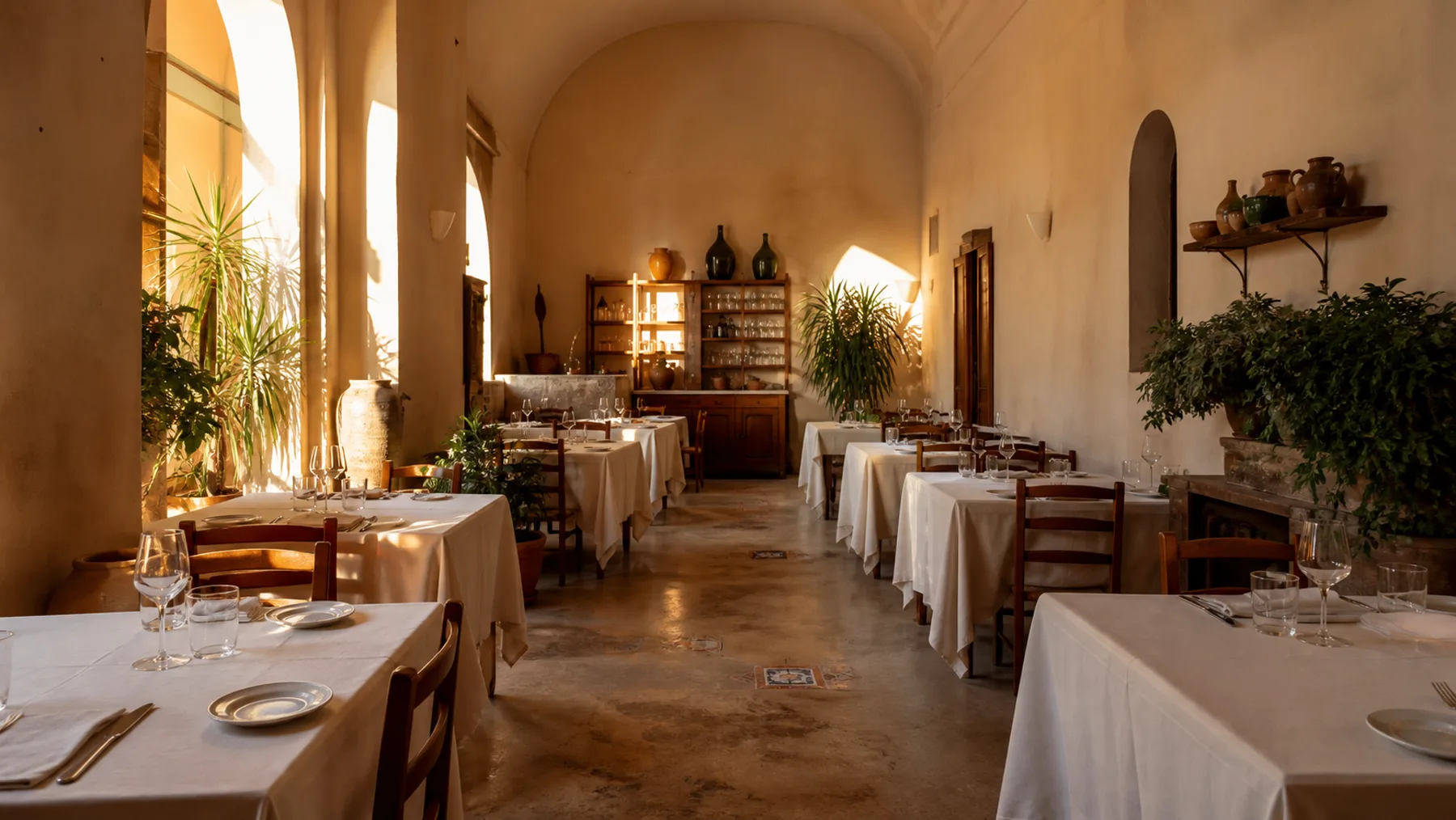
The strictly necessary photographs document the environments that the customer will use directly during their stay or meal. A clear view of the facade helps the guest locate the entrance upon arrival. Wide shots of the bedrooms or the dining room provide a precise idea of space and natural light.
Bathrooms require bright and descriptive images to reassure regarding amenities and cleanliness. Shots of the common areas serve to explain how the guest can move within the property. These images answer the practical questions that always precede the entry of credit card details.
Classification of Images by Functionality
| Shot Type | Function | Assessment |
|---|---|---|
| Exterior facade | Localization | Necessary |
| Rooms and bathrooms | Space evaluation | Necessary |
| Cutlery details | Aesthetics | Unnecessary |
| Posing models | Advertising | Unnecessary |
How to read this data
The table illustrates how to categorize visual files to optimize selection.
Unnecessary Photographs
Close-up images of common objects, such as faucets, pillows, or individual cutlery, are redundant and add no informative value. Extreme details distract the user from the global understanding of the spaces. This kind of shot weighs down the page code without favoring conversion in any way.
Photographs with posing models also often appear artificial and lacking credibility for an independent property. Potential customers look for authenticity and transparency rather than forced advertising representations. Eliminating these unnecessary images simplifies navigation and speeds up the loading of the website.
Practical Alternatives
When it is not possible to organize a professional photo shoot, temporary alternative solutions can be explored. Using a modern smartphone, combined with correct natural lighting, allows for acceptable descriptive shots. However, this path requires a rigorous selection of the produced material.
Another option is to focus on the production of detailed floor plans and highly accurate textual descriptions. A well-drawn floor plan clarifies the layout of spaces better than many poor photographs. However, the total absence of real images remains a major obstacle in the hospitality sector.
Step-by-Step Implementation
The optimization process begins with a complete inventory of all the images currently uploaded to the server. Every single photograph must be evaluated by asking what useful information it conveys to the guest. Images that do not pass this logical scrutiny must be isolated in a separate folder.
The next phase involves resizing the selected files to fit viewing on mobile screens. Images should be compressed using modern formats that maintain quality while drastically reducing file weight. This technical step requires rigor to ensure high performance on every device.
Completing the Process
Once the files are optimized, it is necessary to define the visual hierarchy within the individual pages of the site. The opening image must show the main environment in its entirety to immediately capture attention. Supporting photographs should be arranged in descending order of importance following the user's reading path.
Uploading to the server must include the insertion of descriptive alternative texts for each published photograph. This practice improves site accessibility and facilitates content understanding by search engines. An orderly visual architecture guides the user smoothly and naturally toward booking.
Risks and Technical Limits
The main risk lies in the tendency to excessively alter colors or brightness in post-production. Modifying reality to make spaces appear larger or brighter than they are generates false expectations. Negative reviews are the direct consequence of this discrepancy between photography and reality.
Another technical limit concerns the exclusive use of image formats not supported by older browsers. Neglecting technical compatibility prevents a portion of users from correctly viewing the commercial proposal. The maintenance of the web infrastructure must prevent these technological obstacles.
The Meridia Web Solution
Meridia Web provides a digital architecture designed to manage visual content with efficiency criteria. The system structures the pages to host only the photographic sections strictly necessary for understanding the offer. The platform organizes the material following proven layouts to facilitate navigation.
The product converts formats in real-time to ensure fast loading on any type of device. Meridia Web distributes images through optimized networks, eliminating bottlenecks related to file weight. The management interface allows the operator to update visual material while keeping the infrastructure light and responsive.
Final Recommendation
We recommend conducting a strict review of your photographic archive before publishing it online. Every shot that does not explain a service or document a usable space must be eliminated without hesitation. Visual synthesis protects site performance and respects the potential customer's time.
To implement this rationalization, adopting Meridia Web offers a secure and pre-configured technical perimeter. Commissioning a photographer to produce fewer images, but with greater informative value, optimizes spending. A lean and essential communication is always more effective than a redundant gallery.
Official sources and notes
Sources were verified on the stated date. Scenarios and formulas remain explicitly disclosed.
- Google Search Central2026-09-07
- Eurostat2026-09-07