
Meridia Hospitality Lab
How to Increase Revenue per Guest Without Raising the Room Rate
A cautious framework for measuring guest value and designing services, response and continuity without relying only on the room rate.
The guest journey is larger than the room rate
A room can be sold at the right price while value remains unused elsewhere in the guest journey. An enquiry may arrive without an owner, a booking may carry acquisition costs that are not compared, and a real service may never be explained when it would be useful.
Increasing revenue per guest does not mean forcing an upsell at every step. It means identifying a real need, offering something sustainable and measuring the result with the property's own figures.
From occupancy to contribution per guest
Official tourism statistics measure arrivals, nights, capacity and occupancy. Those indicators are essential, but a property also needs an internal view of the economic value created across the complete journey.
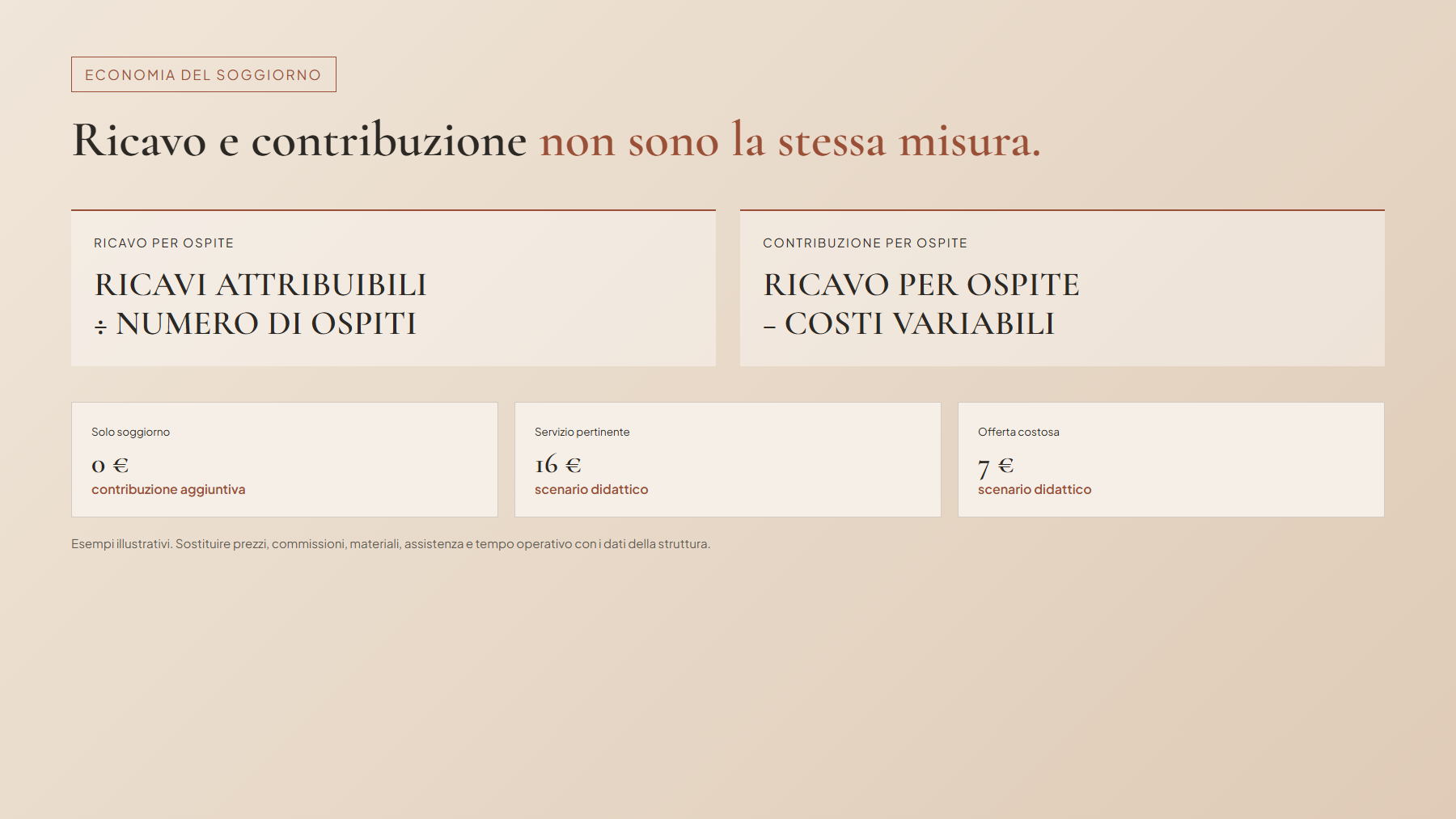
Revenue per guest equals revenue attributable to stays divided by the number of guests. Contribution per guest subtracts the directly associated variable costs. Price, commission, staff time, payment costs and support must therefore be visible before an offer is called profitable.
Illustrative scenario for one guest
| Scenario | Stay revenue | Extra revenue | Variable costs | Extra contribution |
|---|---|---|---|---|
| Stay only | €220 | €0 | €0 | €0 |
| Relevant service | €220 | €28 | €12 | €16 |
| Costly offer | €220 | €38 | €31 | €7 |
How to read this data
Illustrative figures only: they are neither industry averages nor promised results.
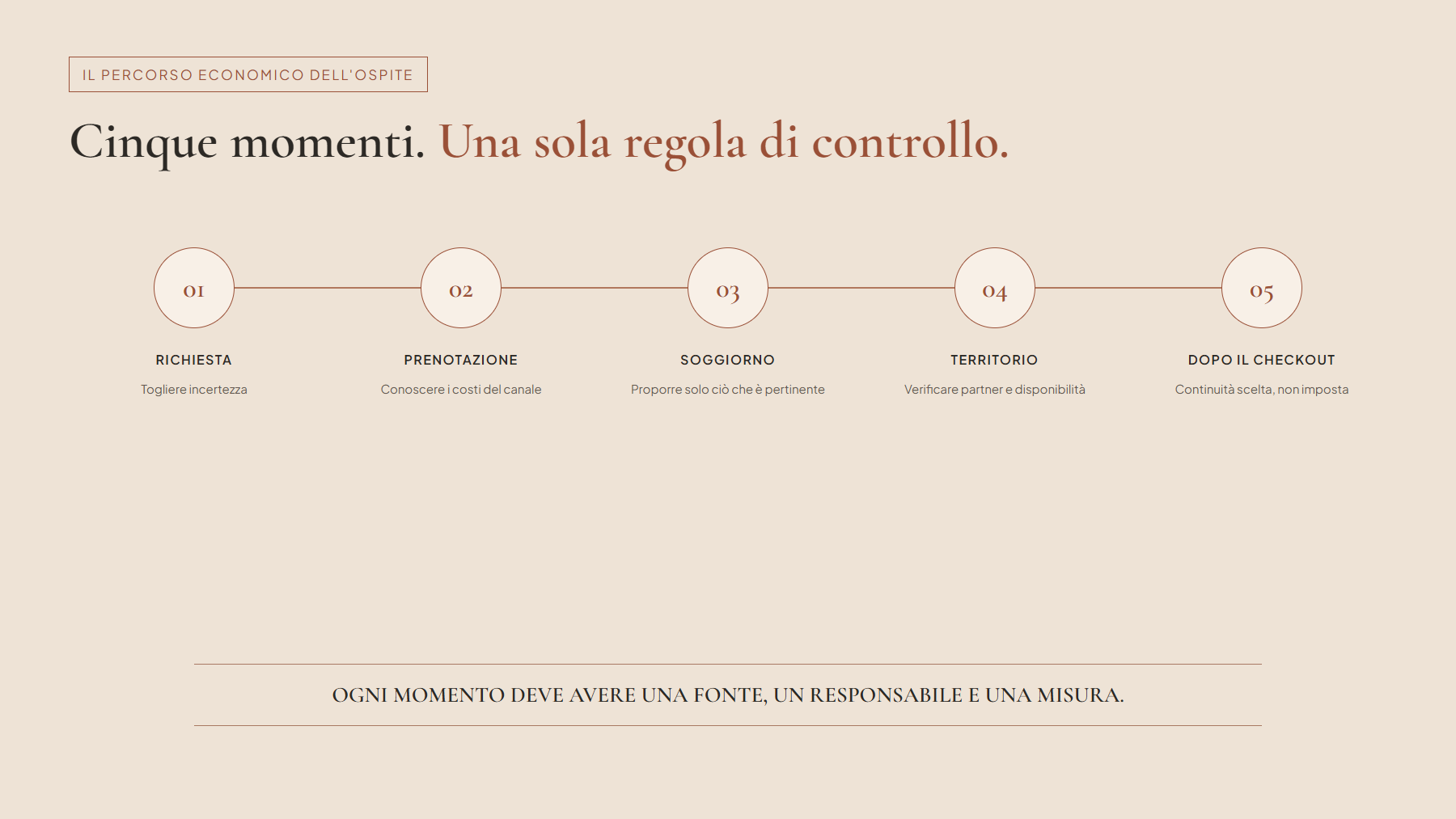
Five moments where value can change
At enquiry stage, clarity and ownership matter before selling anything. At booking stage, direct and intermediated channels must be compared using real acquisition and operating costs. During the stay, one relevant option can be more useful than a catalogue shown to everyone.
The destination can enter the offer through genuine local partnerships whose availability, responsibility and economics are known. After checkout, continuity is possible only when purpose, consent and operational value are clear.
A test with one owner
Choose one point in the journey, such as evening questions about parking and availability. Define the approved source, who maintains it, what a complete response means, the next action and the costs that must be counted.
The test should answer a question belonging to the property, not prove that a Meridia product works. Stop it if clarity, experience or contribution do not improve.
What not to do
Do not raise the price merely because the guest is already on site. Do not publish experiences that staff cannot confirm, buy inventory before demand is tested, send post-stay marketing without the proper conditions, or measure gross revenue while ignoring workload and variable costs.
Healthy value comes from a proposition that is relevant to the guest, verifiable by the property and sustainable for the people who deliver it.
From the rate to the whole journey
The room rate remains decisive, but response, booking, stay, table, place and continuity can also create value. None guarantees a result; each can be designed, measured and stopped if its cost exceeds its benefit.
Sofia addresses the first part of this journey using information approved by the property and a defined next step. Other Meridia lines should enter only after the problem and its economics are clear.
Measure before making an offer
An offer should enter the journey only when the property knows its price, variable costs, staff time, commissions and available capacity. Extra revenue alone does not demonstrate better contribution.
A first measurement can stay small: relevant enquiries, offers actually available, completed purchases, operating problems and the full cost of delivery.
Compare channels using real costs
Direct and intermediated are not moral categories. Each channel brings different demand, costs, data, support and conditions. A useful comparison subtracts the acquisition and operating costs that can genuinely be attributed.
Using equivalent periods and stable definitions helps separate the effect of channel, season, room rate and offer changes.
Capacity and limits come before a catalogue
A service should not be visible when nobody can confirm availability, responsibility and exception handling. Operational capacity protects both guest experience and property margin.
Disclosed scenario: formulas and figures in this guide are teaching tools to be replaced with the property's own data. They are neither industry averages nor promised outcomes.
Official sources and notes
Sources were verified on the stated date. Scenarios and formulas remain explicitly disclosed.