
After Checkout
How Much Value Remains After Hotel Checkout?
A cautious framework for measuring what remains after a stay without confusing service, relationship and marketing.
What remains after checkout
The room has been checked, the key returned and the bill closed. Yet the stay can still leave operational knowledge, a relationship deliberately chosen by the guest and a meaningful connection with the destination.
Post-stay value is not the number of newsletters sent. Continuity is valuable only when it preserves the same respect shown during the stay.
Value does not end with the bill
Recurring questions can improve the next guest's experience: an unclear arrival guide, missing room information or an outdated local recommendation can reveal what the property should maintain better.
A direct relationship is different. It requires a valid choice or another genuinely applicable legal condition. Silence is not automatically lost revenue; it can be a boundary that must be respected.
Day 0, 7, 30 and 90
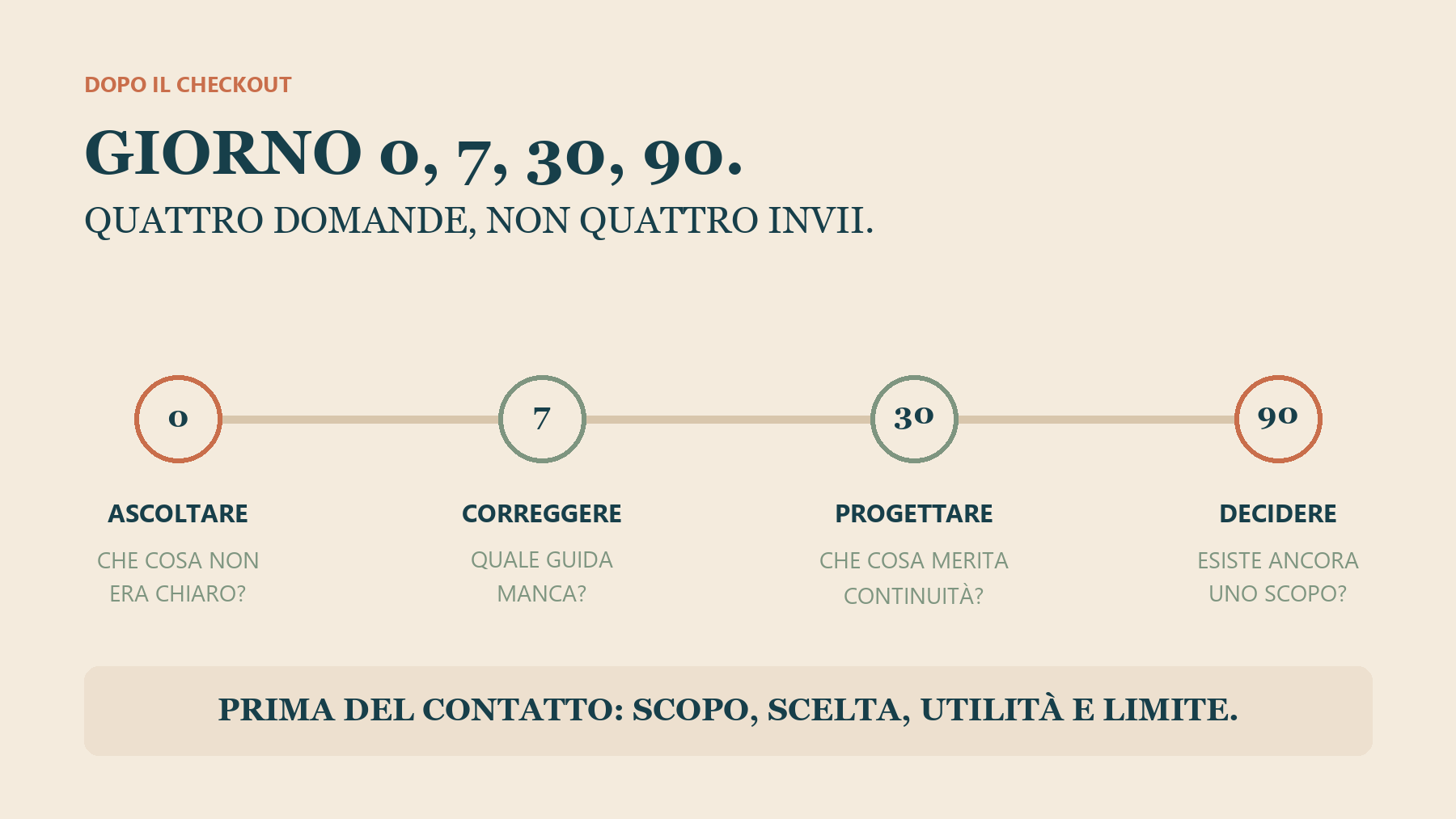
The framework does not prescribe when to send messages. Day 0 asks what remained incomplete; day 7 asks what information would have helped; day 30 asks what aspect of place deserves continuity; day 90 asks whether a recognisable purpose still exists.
A property can use every checkpoint without contacting the guest. The first task is to separate service improvement, editorial content and promotional communication.
Day 0, 7, 30 and 90
| Moment | Question | Possible asset | Limit |
|---|---|---|---|
| Day 0 | What remained unclear? | Service correction | Do not turn support into marketing |
| Day 7 | Which information was missing? | Guide or FAQ | Do not infer preferences |
| Day 30 | What deserves continuity? | Content or collaboration | Verify origin and choice |
| Day 90 | Is there still a clear purpose? | Return or no action | Do not retain data without conditions |
How to read this data
Narrative checkpoints for observing value and limits; they are not recommended sending dates.
Three assets that should not be confused
Service knowledge can be aggregated into clearer pages, arrival instructions and operational corrections without building an individual profile. A chosen relationship is contact the guest accepted under specific, transparent conditions.
Memory of place may become a seasonal guide, a producer story or an on-demand object genuinely connected to the destination. Before a product come identity, demand, margin, responsibility and problem handling.
Consent, soft spam and measurement
GDPR principles require defined purpose, data minimisation and transparency. Italian rules for promotional email add specific conditions. The soft-spam exception is narrow and should not be inferred from a mere enquiry or from the simple availability of an address.
Measurement also has limits. A prudent first project can use aggregate visits, voluntary enquiries, declared codes, attributable bookings and operating costs instead of silently turning every email open into an individual profile. This overview is not legal advice.
A useful experiment without indiscriminate sending
Choose one recurring signal from recent stays and define the problem without naming individuals. Identify the approved information source, create one useful resource, decide how a guest can find or request it voluntarily, and measure use and maintenance with the minimum necessary data.
A property does not lose value by refusing to chase every guest. It loses value when it learns nothing from the stay and cannot distinguish assistance, relationship and promotion.

Improve the service first
The first post-stay action may require no contact at all. Repeated questions, unclear directions and outdated information can become a better page, arrival guide or internal workflow.
This asset is stronger because it responds to an observable need and improves the next experience without presuming individual preferences.
Consent cannot be presumed
An address used for a booking has a specific purpose. Promotional reuse requires applicable, documented conditions; an enquiry or a stay does not automatically authorise every future communication.
Disclosed scenario: days 0, 7, 30 and 90 are narrative checkpoints for organising operational questions. They are not a recommended frequency or an automated sending calendar.
Measure without building a profile
Aggregate visits, voluntary enquiries, use of a resource and maintenance costs may be enough for a first decision. If a metric cannot change an operating choice, it may not need to be collected.
Responsible continuity keeps a recognisable purpose, uses the minimum necessary data and lets the person understand what is happening.
Official sources and notes
Sources were verified on the stated date. Scenarios and formulas remain explicitly disclosed.
- EUR-Lex: GDPR, Article 52026-08-28
- Garante Privacy: Promotional activity and spam2026-08-28
- Garante Privacy: Consent and soft spam decision2026-08-28
- Garante Privacy: Tracking pixels in email2026-08-28